Agentic AI systems rarely fail because of a lack of model capability.
They fail because nothing governs what the model is allowed to execute — or what it is allowed to process.
Most AI frameworks provide coordination, planning, and orchestration. Security is often left to the solution team. That is the wrong architectural boundary. By the time a solution team is wiring in security controls, they are no longer building an application — they are rebuilding framework capabilities.
Security is not a solution-layer concern. It is a first-class architectural capability of the framework itself.
Two Complementary Capabilities
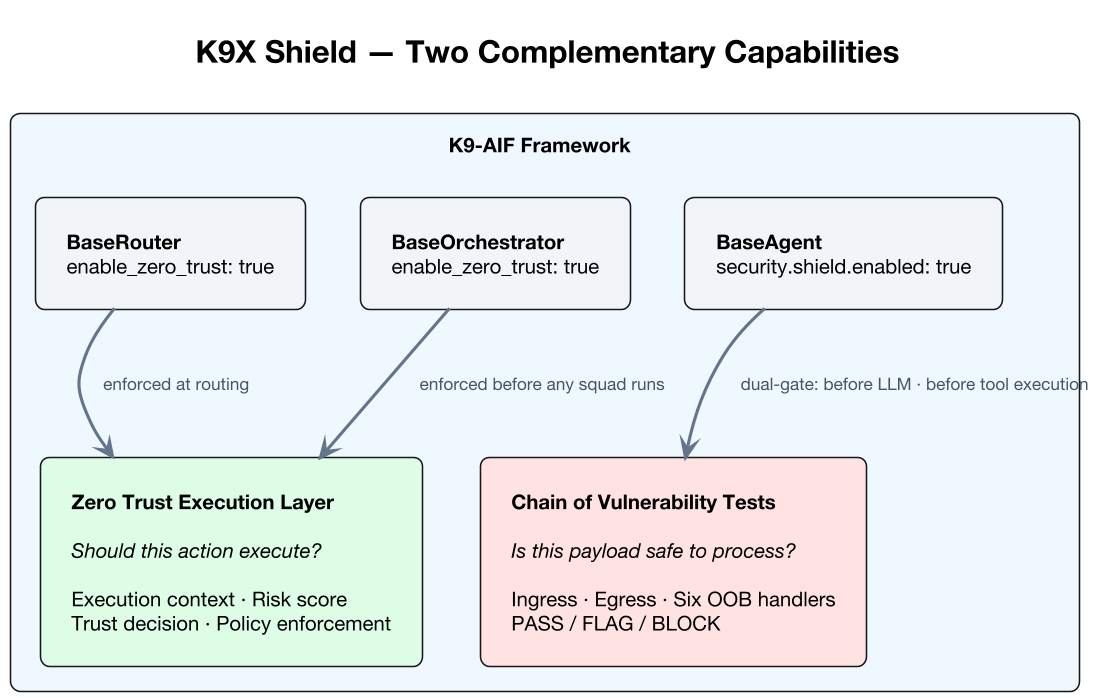
Two complementary capabilities.
Should this action execute? Every agent action carries context — who is initiating it, what data it touches, where it is going. The answer to this question requires evaluating that context against a risk model and producing a decision: allow, deny, allow with obligations, or require approval. This is execution control.
Is this payload safe to process? An authorized agent can still receive a malicious payload. Threat actors embed instructions in documents, search results, and web content. The agent fetches that content and, without architectural safeguards, follows whatever instructions it contains. Stopping that requires inspecting the payload itself — not the execution context. This is payload inspection.
This threat does not stop at the network perimeter. Organizations running LLMs on-premise or in private clouds are equally exposed — the attack arrives as a document, not as a network intrusion. The perimeter is intact. The payload walks through the front door.
The K9X Shield series covers both.
Where This Lives in the Framework
K9-AIF implements both capabilities inside k9_security, a dedicated package within k9_aif_abb:
k9_aif_abb/k9_security/
├── zero_trust/          ← execution control
└── vulnerability/       ← payload inspection
    └── checks/          ← twelve OOB vulnerability handlers
Both layers are Architecture Building Blocks. Both are configuration-driven. Both integrate through BaseAgent’s existing governance hooks.
Enterprise-Level Enforcement
Both capabilities are configuration-driven. That raises a practical question for organizations running multiple K9-AIF solutions: how do you ensure a solution team cannot silently disable a security control?
K9-AIF addresses this through _policy.locked in the ABB config.yaml. Any key listed there is immutable at the enterprise level — SBB configuration cannot override it, and any override attempt is rejected at config load time with an audit warning.
# ABB config.yaml — enterprise policy
_policy:
  locked:
    - enable_zero_trust
    - security.shield.enabled
    - governance.enforce
An SBB that sets enable_zero_trust: false in its own config.yaml will have that override silently rejected. The ABB value holds. The framework logs the attempted override. Every Router, Orchestrator, and Agent receives the enforced value — not what the SBB requested.
Security controls set at the framework level cannot be disabled at the solution level.
The Series
Part 1 — Zero Trust for Agentic Systems
Covers the Zero Trust Execution Layer: execution context, trust decisions, policy enforcement, and how BaseOrchestrator and BaseAgent enforce the layer at every execution boundary.
Part 2 — K9X Shield: Security as an Architectural Capability
Covers the Chain of Vulnerability Tests: VulnerabilityChain, BaseVulnerabilityCheck, the three-state result model (PASS / FLAG / BLOCK), the twelve OOB handlers, dual-gate ingress and egress, and ShieldGovernance.
References
- K9-AIF Framework: https://github.com/k9aif/k9-aif-framework
- PyPI (k9-aif 1.8.2): https://pypi.org/project/k9-aif/
- Blog: https://blog.k9x.ai