A framework can promise governance. A solution built on it still has to be checked. Someone hardcodes an address, an orchestrator imports agent classes when it should know only its squads, a security setting is switched off “for now”. None of that shows up until it matters.
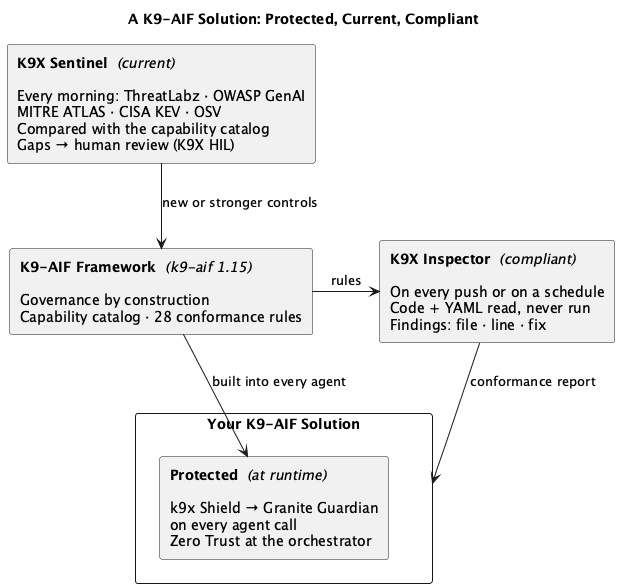
This post is about the two K9X components that close that gap: K9X Inspector, which checks that a solution built on K9-AIF follows the framework’s rules, and K9X Sentinel, which keeps the framework’s defences current as new attacks appear. Together with k9x Shield they answer three questions about any K9-AIF solution:
- Is it protected? k9x Shield and Granite Guardian, built into every agent.
- Is it current? K9X Sentinel, watching new threats every day.
- Does it comply? K9X Inspector, on every push.
From scripts to components
Last year I started with simple scripts. One generated the scaffold code for a K9-AIF application from a template. Others inspected a solution against the rules I cared about: no example running without governance, and no agent calling a language model directly instead of going through the framework. They worked, and they taught me which rules actually catch real mistakes.
As the framework and the ecosystem grew, I wanted every component to be the same kind of thing: UI based, open source, and able to run locally or in a Podman container. So the scaffold scripts became K9X Studio (studio.k9x.ai), and the inspect scripts became K9X Inspector (inspector.k9x.ai), which keeps evolving as the framework does. Every component’s repository has an ubuntu/ folder with a standard build-run.sh that builds and runs it in a container on your own machine. The hosted sites at *.k9x.ai are demonstrations of exactly that.
The first test: the framework’s own examples
The first solutions I ran through the Inspector were the framework’s own examples. I expected a few warnings. I got a report like this one for ACME Health Insurance:
NON-COMPLIANT: 68% of 28 rules pass. 0 critical, 20 violations, 8 warnings, 1 recommendation.
The findings were real:
- A hardcoded private IP address in
config.yaml, the address of a machine in my home lab. It worked on my network and nowhere else. - Orchestrators importing agent classes. K9-AIF’s three-layer rule says an orchestrator knows its squads and a squad knows its agents. Three orchestrators reached past that.
- Shield not enabled in the application’s configuration.
- A Python file that did not parse.
I loved seeing these. Not because the examples were wrong, but because a rule set found them, the same way every time, with the file, the line and the fix. A code review can miss a hardcoded address on line 84. A rule doesn’t.
Another out-of-the-box example, EOC (the Enterprise Insurance Operations Center), kept per-squad YAML files next to the one file the framework actually loads, and six of the seven had drifted from it. Turning on Granite Guardian in an example’s configuration showed that the setting wasn’t yet wired into the framework’s governance by construction, so it is now (k9-aif 1.15.0). The DAS (Defense Acquisition System) reference deployment, the framework’s showcase, had a few minor findings too, now fixed. Today none of the framework’s 12 examples has a violation, and five are fully compliant.
The Framework latest published release is: pypi.org/project/k9-aif k9-aif 1.15.0
Protected: k9x Shield, Granite Guardian, Zero Trust
Since k9-aif 1.15, governance is part of the agent contract. The framework wraps every agent the moment it is defined: the request is checked before the agent runs and the reply after it, and an agent with no governance configured refuses to run in production. The application turns it on once, in config.yaml:
- k9x Shield: deterministic checks (prompt injection, personal data, outbound links, tool arguments and more), mapped to the OWASP Top 10 for LLM Applications.
- Granite Guardian: semantic screening after Shield, for the paraphrased attacks a pattern can’t catch. If Guardian is unreachable, requests are refused, not passed through.
- Zero Trust: identity, role and risk checks at the orchestrator.
K9X Satan fires real attacks at a governed pipeline to show what these layers contain.
Current: K9X Sentinel
Attacks change faster than any rule list. Every morning K9X Sentinel reads the sources security teams follow: Zscaler ThreatLabz, OWASP GenAI, MITRE ATLAS, CISA KEV, agent-security researchers, and OSV for the framework’s own dependencies.
It compares each new threat with the framework’s capability catalog, a machine-readable list of every Shield check, Guardian risk and Zero Trust component, mapped to OWASP. A framework test fails if a control exists without being listed, so Sentinel judges against what the code really does. Threats the framework doesn’t fully cover go to a person for review through K9X HIL. Sentinel itself never changes code. An approved gap becomes a private security advisory or, for a public dependency CVE, an issue.
Sentinel reads attacker-written content all day, so it is built to survive it: its analysis model has no tools, every answer is validated against the catalog, and every finding is decided by a human.
Compliant: K9X Inspector
K9X Inspector applies the framework’s 28 conformance rules to a solution:
- ABB contracts: agents extend a framework agent base class.
- Three-layer decoupling: router, orchestrator, squad and agent each know only the layer below.
- One model path: agents never call a language model directly. Every call goes through the framework’s single, consistent entry point (
llm_invoke(), backed by the model factory and router), so governance, retries and the audit trail apply to every call, whichever model or provider is behind it. - Governance: Shield enabled with its checks, Guardian failing closed, production mode, orchestrators screening their own input.
- Hygiene: no secrets in configuration, no committed
.env, no private IP addresses, valid squad and agent YAML, a current framework version.
It reads the code and the YAML without importing or running anything, so it is safe to point at any repository. Each finding is ranked critical, violation, warning or recommendation, with the file, the line and the fix, and each run produces a compliance report and conformance guidelines (below). Tracked applications are inspected again on every push (GitHub webhook) or on a schedule.
Two documents for every inspection: the record and the plan
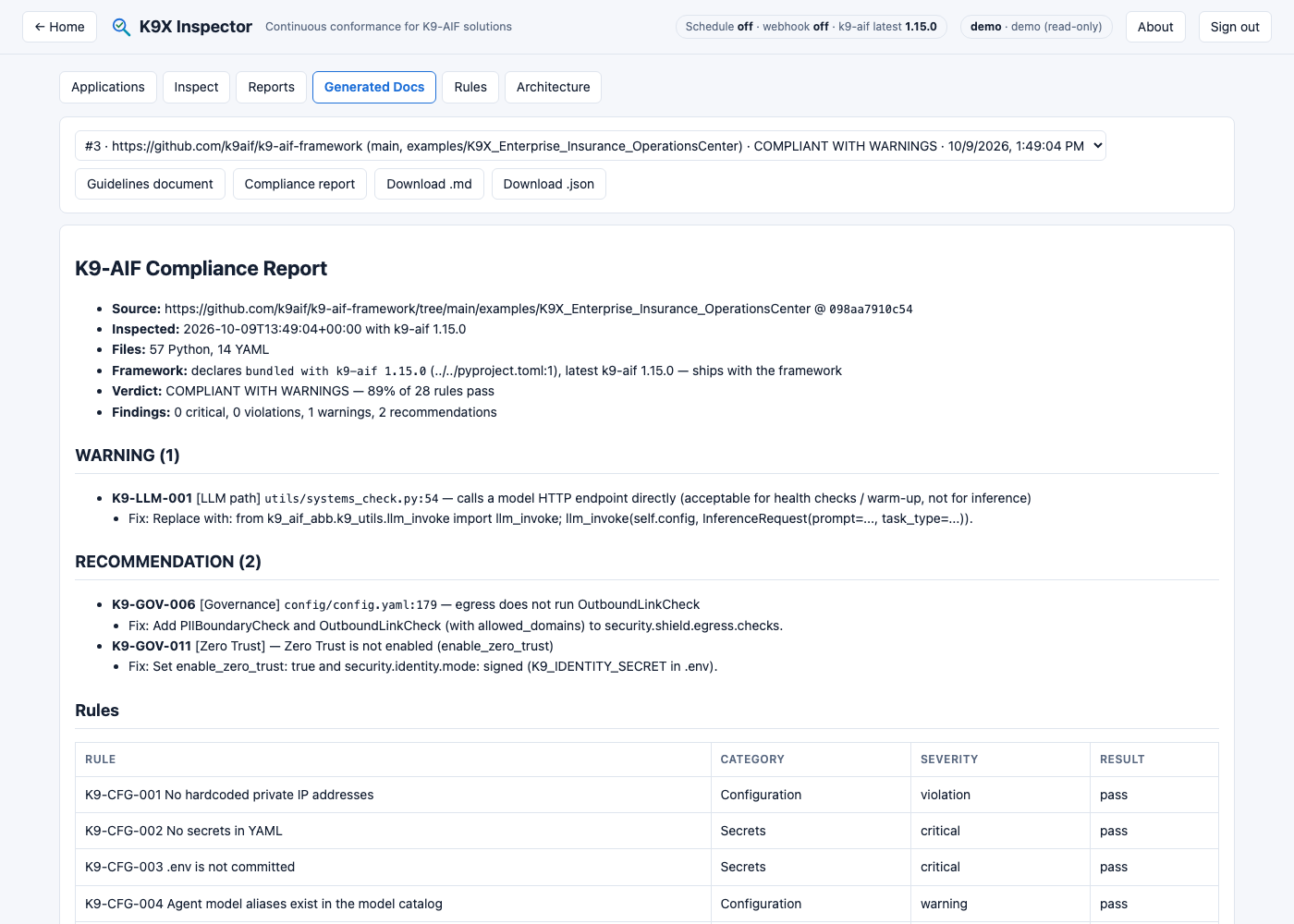
A list of findings tells you what is wrong. The Inspector also records exactly what was checked, and tells you what to do about it. Every run produces two documents in the Inspector’s Generated Docs tab, each downloadable as Markdown or JSON (for other tools to read).
The Compliance Report is the record: the source and the exact commit inspected, when and with which k9-aif version, the framework version the solution declares against the latest, the verdict, every finding grouped by severity (rule, category, file and line, fix), and the full table of all 28 rules with pass or fail. It is what you keep when someone asks what was checked and when.
The Conformance Guidelines document is the plan:
- Where the solution stands: the verdict, the share of rules passing, and the count at each severity.
- A remediation plan, in order: violations first (fix before production), then warnings (next iteration), then recommendations (when the code is next touched).
- For every item: the rule, why the framework has it, every place it is broken (file and line), and how to fix it.
- A starting configuration for Shield, Granite Guardian and Zero Trust to copy into
config.yaml. - How to keep it compliant: the framework practices the rules enforce, and the CI command that stops a violation from coming back.
This is the first item from the ACME Health Insurance guidelines:
1. No hardcoded private IP addresses (K9-CFG-001, 2 places)
Why: Private IP addresses in code or config tie the solution to one network and leak its layout.
config/config.yaml:8: private IP addressconfig/config.yaml:84: private IP addressFix: Read the address from an environment variable with a localhost default.
The same examples, inspected again on the released k9-aif 1.15.0, now read differently: ACME Health Insurance went from non-compliant at 68% to compliant at 93%, ACME Support Center from 75% to 93%, and EOC to compliant with warnings at 89%. Here is EOC’s guidelines document in the Inspector’s Generated Docs tab. Its second item is the OutboundLinkCheck recommendation from the loop described below:
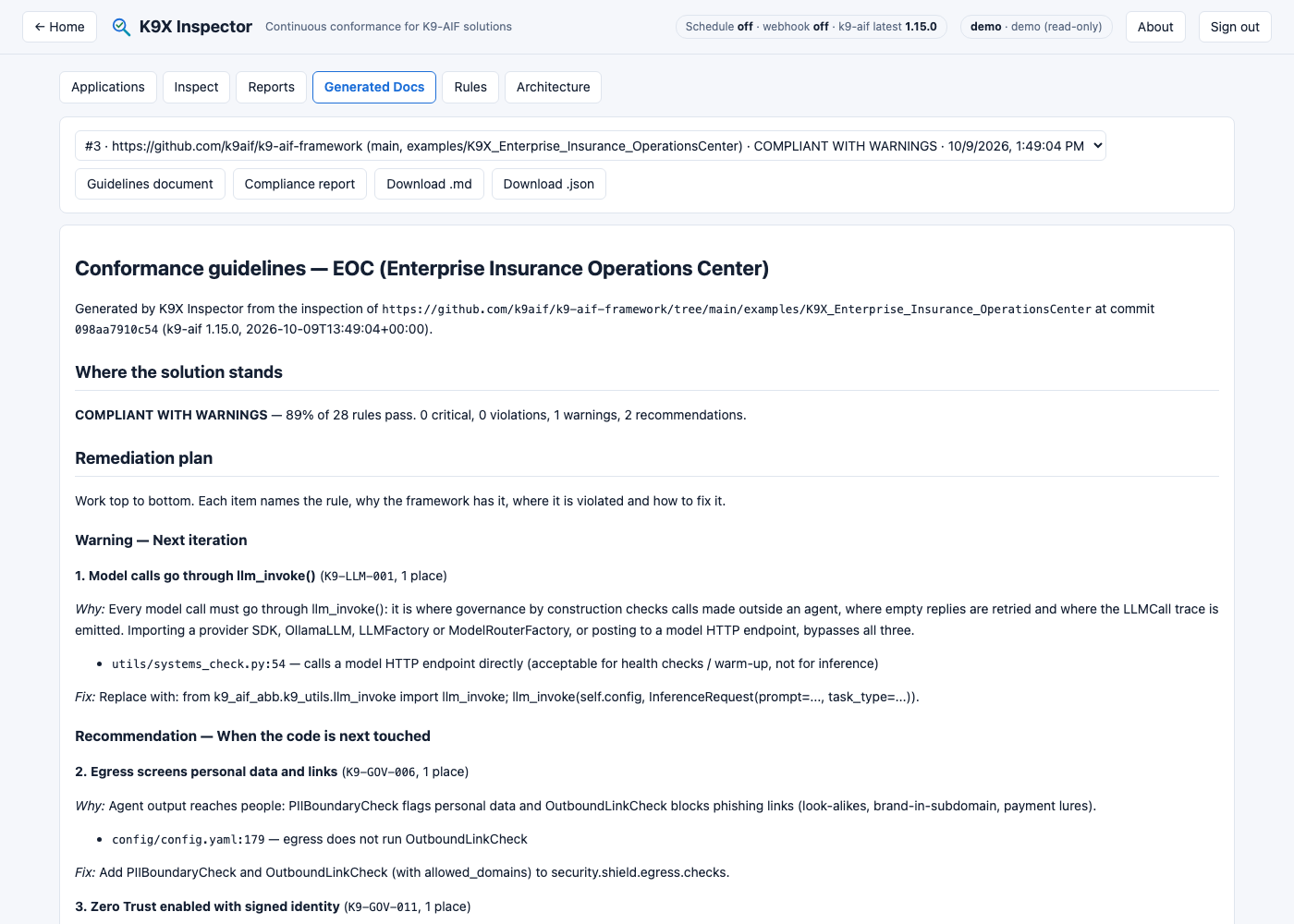
A developer can work through it top to bottom without knowing the framework’s rules in advance. That is the point: the rules carry the framework’s design knowledge, and the guidelines hand it to whoever is fixing the code.
The rules ship with the framework itself, so the same check also runs from the command line or in CI:
pip install k9-aif
k9aif inspect path/to/your/solution --fail-on violation
An organisation can add its own rules by registering them with the framework’s rule registry.
Does it work only for K9-AIF? Yes, and that is deliberate. The rules encode the object-oriented analysis and design discipline the framework is built on: abstract contracts that concrete building blocks extend, each layer knowing only the one below it, one entry point for every model call, governance that cannot be skipped. Those principles are what make a K9-AIF solution strong, and the Inspector holds every solution built on the framework to them. It is not a general linter; it points at any solution built on K9-AIF and shows exactly where it falls short of the framework’s design.
The rules get stricter over time
The three pieces form one loop, and it only tightens. Some steps are automatic; the important ones are decided by a person:
- Sentinel finds a threat the framework doesn’t fully cover. This part runs by itself, every morning.
- A person reviews it in K9X HIL. If it is a real gap, a private security advisory opens.
- The framework closes the gap with a new or stronger control, and lists it in the capability catalog. A framework test fails if a control is missing from the catalog.
- The Inspector gets a rule, added or updated, that checks every solution actually uses it.
- A person signs off the fix in K9X HIL, against a definition-of-done checklist: the control, the catalog entry, the Inspector rule, a regression test and the release.
- A new k9-aif release raises the bar for every solution built on it.
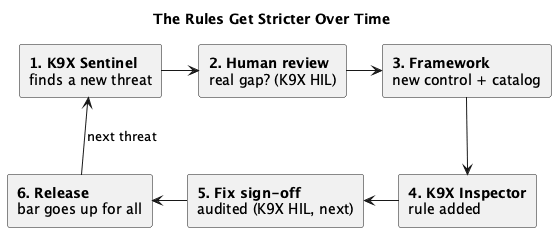
Step 5 is the next piece to be built. The point is accountability: the sign-off records who checked each item, when, and the evidence they pointed to (the commit, the catalog entry, the rule, the version). Whoever closes a gap is on record for it, which makes the loop an audit trail as well as a process.
One real example: the 2026 Zscaler ThreatLabz research described a chatbot scam that collects an ID, invents a debt and hands over a payment link. k9-aif 1.14 added OutboundLinkCheck, which blocks lookalike domains, brands hidden in subdomains and similar tricks in the links an agent sends out. It went into the capability catalog, and the Inspector’s egress rule now tells any solution that doesn’t run it to add it. The DAS report shows exactly that recommendation.
So a solution built on K9-AIF doesn’t just pass a fixed checklist once. Each time the framework learns about a new attack, the bar for every solution built on it goes up, and the Inspector shows each team where it now falls short.
What’s next: checks before every commit
Today the Inspector runs on a push or on a schedule, after the code is already in the repository. The next step is hooks: the same rules running before and after git operations on the developer’s own machine, so a violation is caught before it is ever committed. They run in git itself, so they work the same way alongside AI coding assistants such as Claude Code and IBM Bob, or with no assistant at all, and each team can turn them on or off.
Try it
- K9X Inspector: inspector.k9x.ai, demo login
demo/demo. Source: github.com/k9aif/k9x-inspector. - K9X Sentinel: sentinel.k9x.ai, demo login
demo/demo(gap details stay private). - All of it on one page: dashboard.k9x.ai.
Each runs on your own machine with ubuntu/build-run.sh from its repository.
Related posts: