Teams rarely start from a blank page. One team has a CrewAI crew in production, another built its workflow as a LangGraph graph, and a third standardized on Claude and the Claude Agent SDK. Rewriting all of them onto one framework isn’t realistic, and it isn’t necessary.
This post shows how K9-AIF works alongside all three. You keep your crew, your graph or your Claude session exactly as it is. K9-AIF wraps it and brings the same governance and security to each:
- k9x Shield: deterministic checks mapped to the OWASP Top 10 for LLM Applications and to the agentic threat vectors Zscaler ThreatLabz describes.
- Granite Guardian: a semantic safety layer on top of Shield, run as mandatory and fail-closed.
- Zero Trust: identity, role and risk checks before anything executes.
- Governance enforced by inheritance: every adapter extends the same
BaseOrchestratorcontract as a native K9-AIF orchestrator, so nothing is special-cased and nothing depends on a developer remembering to call a check.
The first part explains the shared layer. The three sections after it are self-contained, so jump straight to the one you use:
The material comes from the integration section of the K9X ecosystem paper submitted to IEEE Access, checked against the framework’s current code.
The shared layer: what every adapter inherits
One shape for every framework
All three adapters follow the same three-part shape:
| Part | Job |
|---|---|
Facade (K9CrewAIAdapter, K9LangGraphAdapter, K9ClaudeAgentSDKAdapter) |
Accepts a K9-AIF payload and returns a K9-AIF result |
| Payload mapper | Translates between K9-AIF payloads and the framework’s own input and output, once, at the boundary |
| Orchestrator adapter | Extends BaseOrchestrator and BaseAdapter, applies governance, and runs the wrapped framework |
The wrapped object (a Crew, a compiled graph or an SDK session) is not modified. Its tasks, nodes, edges and prompts are exactly what its authors wrote. The adapter sits at the Orchestrator layer of K9-AIF’s Router → Orchestrator → Squad → Agent hierarchy, because a crew, a graph and an agent session each orchestrate their own steps.
k9x Shield: the deterministic checks
Shield is a Chain of Responsibility: a payload passes through a sequence of checks, and each check looks for one class of attack. A check either flags (logged, the payload continues) or blocks (a PermissionError, nothing downstream runs). Ingress checks run before a model sees the input; egress checks run on what comes back.
| Shield check | What it catches | OWASP LLM Top 10 (2025) | ThreatLabz vector |
|---|---|---|---|
PromptInjectionCheck |
Instructions hidden in input | LLM01 Prompt Injection | Indirect prompt injection |
PIIBoundaryCheck, PIIRequestCheck |
Personal data crossing a boundary, or being asked for | LLM02 Sensitive Information Disclosure | |
HardcodedCredentialCheck |
Secrets in a payload or output | LLM02 Sensitive Information Disclosure | |
MemoryPoisoningCheck |
Instructions planted in session memory | LLM04 Data and Model Poisoning | Memory poisoning |
OutputSanitizationCheck |
Output that would inject into HTML, JS or templates | LLM05 Improper Output Handling | |
ToolAuthorizationCheck, ToolArgumentCheck, ExecutionGuardCheck |
Unapproved tools, dangerous arguments, unsafe execution | LLM06 Excessive Agency | Shadow AI and tool abuse |
SemanticDriftCheck |
Output drifting away from the task | Goal hijacking and privilege escalation | |
SystemPromptLeakageCheck |
The agent’s own instructions leaking out | LLM07 System Prompt Leakage | |
InputSizeCheck, RequestFrequencyCheck |
Oversized inputs, request floods | LLM10 Unbounded Consumption |
You choose which checks run, per direction, in configuration. Adding a new check for the next reported attack vector means adding one handler; nothing else changes.
Granite Guardian: the semantic layer, mandatory
Shield’s checks are fast, explainable and cost no model call, but a determined attacker can paraphrase or encode around a literal rule. IBM’s Granite Guardian (granite4.1-guardian:8b, served by Ollama) judges meaning rather than wording, so it catches what survives the rules.
The two are layered, never swapped: ChainedGovernance runs Shield first and Guardian after it, and both stay active.
In the solutions I build, Guardian is mandatory and fails closed. If Guardian times out or can’t be reached, its verdict is UNAVAILABLE, and the on_unavailable: fail_closed policy (the default) refuses the request. It is never quietly treated as a pass.
Zero Trust: before anything executes
Governance defines policy; Zero Trust enforces it at execution time. BaseOrchestrator.apply_zero_trust() builds an execution context and runs it through the DefaultZeroTrustGuard:
- compromise check;
- role-based authorization;
- sensitive-data protection and masking;
- risk scoring.
The result is a trust decision: allow, deny, or allow with obligations such as masking. A denial stops the request before the wrapped framework is ever called. Zero Trust is opt-in per orchestrator (enable_zero_trust: true). More in K9X Shield, Part 1: Zero Trust for Agentic Systems.
Wiring it once
The same governance object serves all three adapters:
from k9_aif_abb.k9_security.vulnerability.shield_governance import ShieldGovernance
from k9_aif_abb.k9_governance.guardian_governance import GuardianGovernance
from k9_aif_abb.k9_governance.chained_governance import ChainedGovernance

# Shield first (deterministic), Granite Guardian second (semantic, fail-closed)
governance = ChainedGovernance(
    ShieldGovernance(config=config),
    GuardianGovernance(config=config),
)
security:
  shield:
    enabled: true
    ingress:
      checks: [InputSizeCheck, PromptInjectionCheck, PIIBoundaryCheck]
    egress:
      checks: [SemanticDriftCheck, ToolArgumentCheck, ExecutionGuardCheck, PIIBoundaryCheck]

governance:
  guardian:
    enabled: true
    model: granite4.1-guardian:8b
    on_unavailable: fail_closed      # Guardian down = request refused

enable_zero_trust: true
Every Shield verdict, Guardian verdict and Zero Trust decision is also emitted to K9-AIF’s trace-event bus, so the audit trail looks the same whichever framework did the work.
1. CrewAI
What gets wrapped: an unmodified CrewAI Crew, a team of role-based agents working through tasks.
How: K9CrewAIAdapter (the facade) hands the payload to CrewAIOrchestratorAdapter, which extends BaseOrchestrator and BaseAdapter. The crew is governed through inheritance, exactly like a native K9-AIF orchestrator; there’s no special case in the governance pipeline.
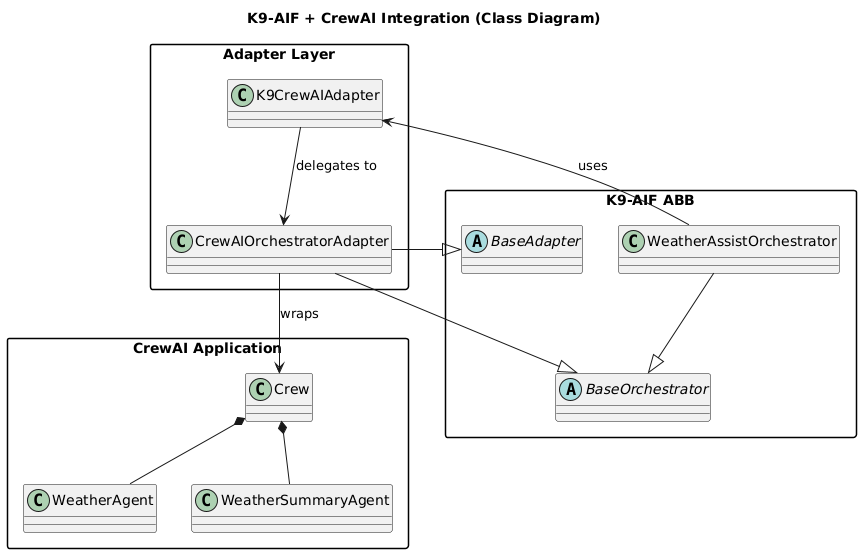
The request path:
- Zero Trust: the K9-AIF orchestrator that owns the crew calls
apply_zero_trust(). A denial ends the request here. - Ingress governance:
apply_pre_governance()runs Shield’s ingress checks, then Granite Guardian, on the crew’s input. A prompt-injection attempt is refused beforecrew.kickoff()runs. - The crew runs:
crew.kickoff(inputs=...), untouched. - Egress governance:
apply_post_governance()runs Shield’s egress checks and Guardian on the crew’s result before it’s returned. - Observability: the adapter publishes
CrewAISessionStartedandCrewAISessionCompleted, alongside the governance trace events.
from k9_aif_abb.k9_adapters.crewai.k9_crewai_adapter import K9CrewAIAdapter
from k9_aif_abb.k9_core.orchestration.base_orchestrator import BaseOrchestrator

class ClaimsOrchestrator(BaseOrchestrator):
    def __init__(self, config, governance, crew):
        super().__init__(config=config, governance=governance)
        self.crew_adapter = K9CrewAIAdapter(crew=crew, config=config, governance=governance)

    def execute_flow(self, payload):
        trust = self.apply_zero_trust(payload)
        if not trust["allowed"]:
            raise PermissionError(trust["reason"])
        return self.crew_adapter.execute(trust["payload"])   # Shield + Guardian inside
Try it: the weather_assist example in the framework repository wraps a two-agent crew (look up the weather, then summarize it) around a real Open-Meteo call. Its web UI shows a prompt-injection “city” being refused by Shield before the crew starts.
2. LangGraph
What gets wrapped: an unmodified compiled StateGraph (a CompiledStateGraph, which exposes invoke()): nodes, edges and state, exactly as built.
How: K9LangGraphAdapter and LangGraphOrchestratorAdapter follow the identical facade, orchestrator adapter and payload mapper shape as CrewAI. The graph sits at the Orchestrator layer for the same reason a crew does: a compiled graph orchestrates its own nodes. Only the wrapped construct differs.
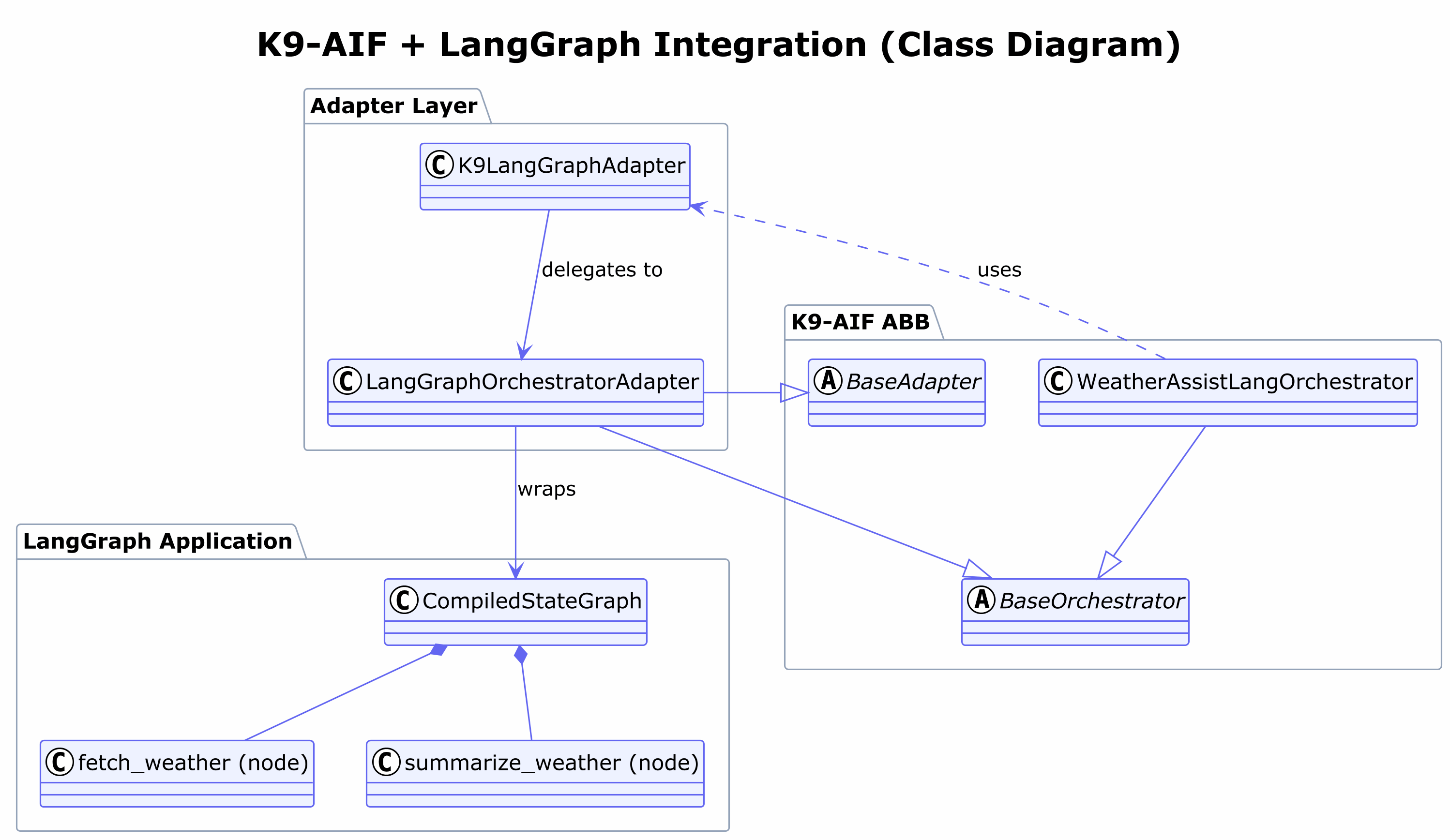
The request path:
- Zero Trust:
apply_zero_trust()in the owning K9-AIF orchestrator. - Ingress governance: Shield ingress, then Granite Guardian, on the graph’s input state, before
invoke()is called. - The graph runs:
graph.invoke(...), with every node and edge untouched. - Egress governance: Shield egress and Guardian on the final state before it’s returned.
from k9_aif_abb.k9_adapters.langgraph.k9_langgraph_adapter import K9LangGraphAdapter

graph = builder.compile()                 # your existing LangGraph graph
graph_app = K9LangGraphAdapter(graph=graph, config=config, governance=governance)

result = graph_app.execute({"query": "What's the weather in Atlanta?"})
Because the governance object is the same one used for CrewAI, the policy is identical: the same Shield checks, the same Guardian model, the same fail-closed rule. A team moving a workflow from a crew to a graph, or running both, doesn’t re-implement security.
Try it: weatherAssistLang in the framework repository mirrors weather_assist exactly: the same two-step task, the same real weather call, the same governance configuration, wrapped around a two-node graph instead of a two-agent crew.
3. Claude Agent SDK
What gets wrapped: a Claude Agent SDK session, with Claude running its own agent loop, calling tools and optionally spawning subagents.
How: ClaudeAgentSDKOrchestratorAdapter extends the same BaseOrchestrator and BaseAdapter contracts, and acts as the sole capability broker. Tools reach the SDK only through the adapter’s own registry (ToolCapability entries), and the SDK’s can_use_tool callback, the single path by which any tool call is allowed or denied, is wired straight into K9-AIF governance.
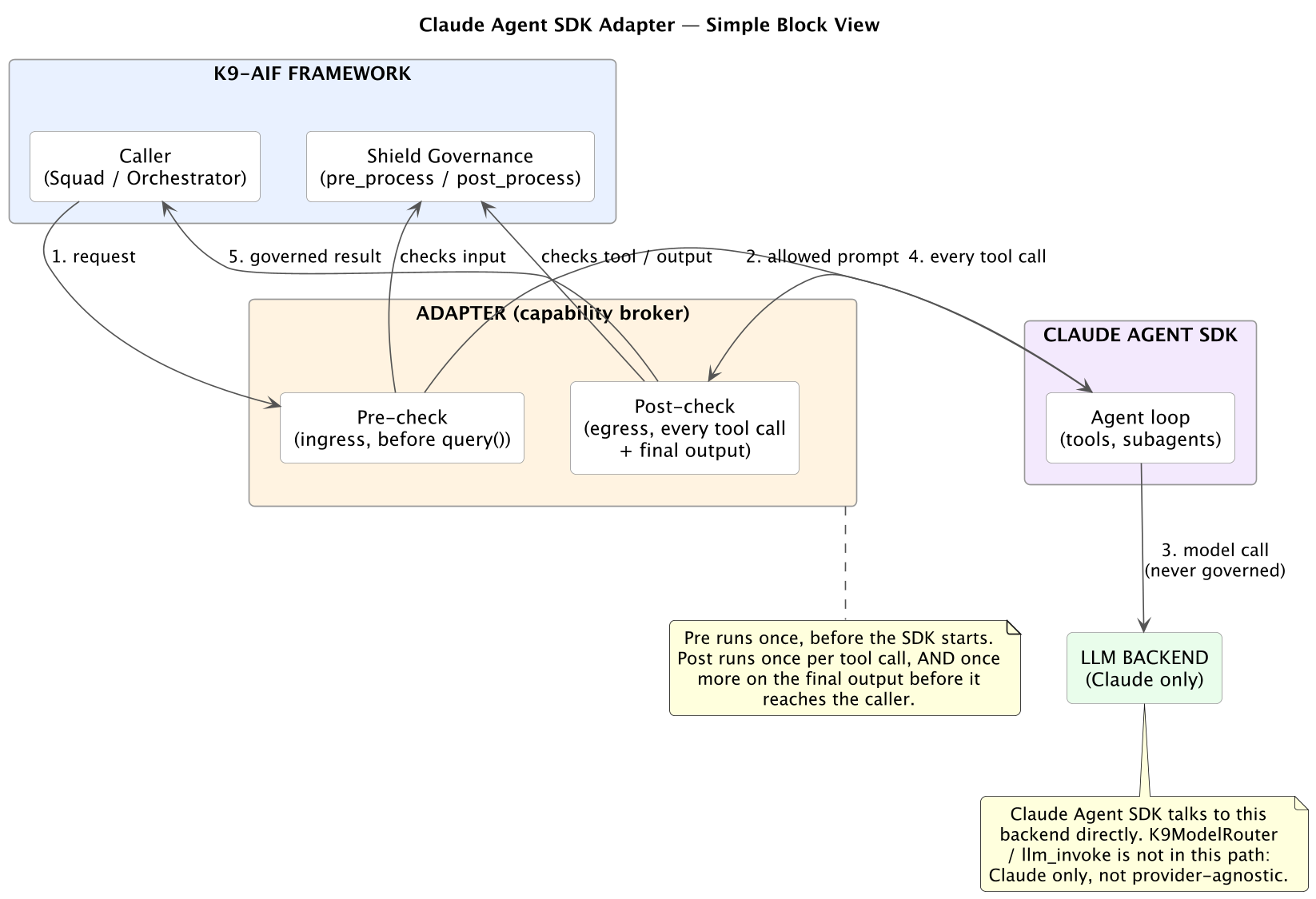
This adapter governs at four points, not two:
- Zero Trust:
apply_zero_trust()runs inside the adapter before the session starts; a denial means no SDK call is made at all. - Ingress governance: the prompt passes through Shield’s ingress checks and Guardian.
- Every tool call: each tool call Claude attempts, including calls from SDK-spawned subagents, goes through
can_use_toolintoapply_post_governance(). APermissionErrorfrom Shield or Guardian becomes a structural tool refusal (PermissionResultDeny). It isn’t an application-level check someone could forget. - Egress governance: the final output passes through Shield’s egress checks and Guardian.
from k9_aif_abb.k9_adapters.claude_agent_sdk.claude_agent_sdk_orchestrator_adapter import (
    ClaudeAgentSDKOrchestratorAdapter, ToolCapability)
from k9_aif_abb.k9_adapters.claude_agent_sdk.k9_claude_agent_sdk_adapter import K9ClaudeAgentSDKAdapter

lookup = ToolCapability(name="lookup_policy", description="Look up a policy by number",
                        input_schema={"policy_no": str}, handler=lookup_policy)

orchestrator = ClaudeAgentSDKOrchestratorAdapter(
    capabilities=[lookup],
    system_prompt="You are a claims assistant.",
    config=config, governance=governance,        # same Shield + Guardian object
    enable_zero_trust=True,
)
claude_app = K9ClaudeAgentSDKAdapter(capabilities=[lookup], orchestrator_adapter=orchestrator)

result = claude_app.execute({"query": "Is policy P-1042 active?"})
One boundary to know about: K9-AIF governs everything this session does: its input, every tool call and its output. The model’s own reasoning stays with Claude: the SDK has no seam for injecting a different model, so K9-AIF’s model router doesn’t choose the model for this adapter. I think of it as action governance without inference governance, and it’s a stated boundary rather than a gap. My earlier post, Claude Agent SDK in K9-AIF: Govern What It Does, Not How It Thinks, goes deeper on it.
The takeaway
Three very different ways of building agents (a crew of roles, a compiled graph, an autonomous session) plug into K9-AIF through one shape. Each inherits the same governance from the same base contract:
| CrewAI | LangGraph | Claude Agent SDK | |
|---|---|---|---|
| Wrapped, unmodified | Crew |
CompiledStateGraph |
SDK session |
| Zero Trust | in the owning orchestrator | in the owning orchestrator | inside the adapter, before the session |
| Shield + Guardian on input | ✓ | ✓ | ✓ |
| Shield + Guardian on every tool call | ✓ (via can_use_tool) |
||
| Shield + Guardian on output | ✓ | ✓ | ✓ |
| Guardian unavailable | request refused | request refused | request refused |
To bring a fourth framework in, SKILLS.md Skill 16 in the framework repository documents the recipe: a facade, a payload mapper, and an orchestrator adapter that extends BaseOrchestrator.
References
- K9-AIF framework: github.com/k9aif/k9-aif-framework (
pip install k9-aif); adapters ink9_aif_abb/k9_adapters/, examples inexamples/weather_assistandexamples/weatherAssistLang - From Agents to Architecture: Integrating CrewAI into K9-AIF
- K9X Shield: Chain of Vulnerability Tests
- K9X Shield, Part 1: Zero Trust for Agentic Systems
- Claude Agent SDK in K9-AIF: Govern What It Does, Not How It Thinks
- OWASP Top 10 for LLM Applications (2025): owasp.org
- Zscaler ThreatLabz: zscaler.com/threatlabz
- IBM Granite Guardian: huggingface.co/ibm-granite