Date: 2026-06-05 Author: Ravi Natarajan
K9 Enterprise Context Fabric — k9_streams
K9-AIF Phase 1 of k9_streams introduces the K9 Enterprise Context Fabric — a governed transport layer that continuously streams enterprise context into agentic flows.
The core principle:
IBM Confluent, Kafka, Redpanda, and IBM Event Streams are SBBs. K9-AIF defines how agentic flows consume, govern, and reason over what they stream.
Two Loops, One Framework
The architecture separates two completely independent processes:
─────────────────────────────────────────────────────
BACKGROUND  (always running, continuous)

  Enterprise System → Kafka topic
        │
        ▼
  KafkaEventFabric
        │  wraps in EventEnvelope
        ▼
  EventGovernanceGate
        │  PERMIT / REDACT / BLOCK / AUDIT
        ▼
  BaseContextProjection
        │  source schema → agent vocabulary
        ▼
  BaseContextWindow  ← silently accumulating governed context

─────────────────────────────────────────────────────
FOREGROUND  (triggered on demand)

  Client event → Router → Orchestrator
                               │
                               │  queries ContextWindow
                               ▼
                           Squad → Agent → LLM
                           (grounded in live enterprise state)
─────────────────────────────────────────────────────
The streaming and governance are done before any agent task arrives. When the Orchestrator picks up a task, the context window is already populated. The agent does not wait for streams — it queries what is already there.
This is the difference between an LLM assistant and an enterprise cognitive agent.
The Architecture
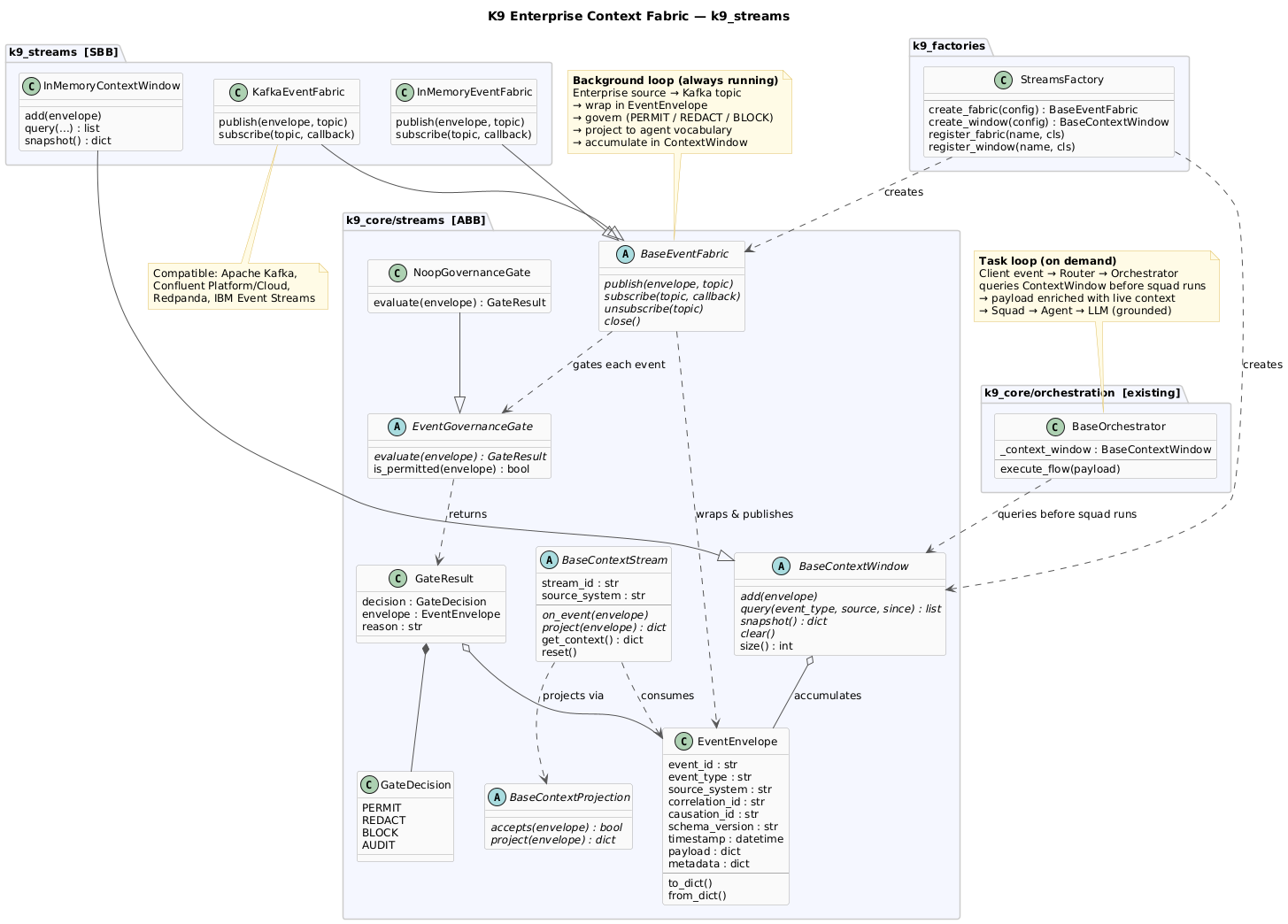
ABB Contracts (k9_core/streams/)
Every ABB is provider-agnostic. Confluent, Redpanda, and IBM Event Streams are all SBBs of the same contract.
EventEnvelope — every enterprise event, regardless of source, is wrapped in a standard envelope before anything else in the framework sees it:
@dataclass
class EventEnvelope:
    event_type:     str        # "sap.policy.updated"
    source_system:  str        # "sap"
    payload:        dict       # raw event data
    event_id:       str        # UUID auto-generated
    correlation_id: str        # links related events
    causation_id:   str        # parent event — causal chain
    timestamp:      datetime
    metadata:       dict       # sensitivity, tenant, routing hints
BaseEventFabric — transport contract. Implementations handle IBM Confluent, Kafka, in-memory, or any streaming provider:
class BaseEventFabric(ABC):
    def publish(self, envelope: EventEnvelope, topic: str) -> None: ...
    def subscribe(self, topic: str, callback) -> None: ...
    def close(self) -> None: ...
EventGovernanceGate — every event passes through a governance gate before reaching agents. Four outcomes:
| Decision | Meaning |
|---|---|
PERMIT |
Event passes unchanged |
REDACT |
Sensitive fields removed, then forwarded |
BLOCK |
Stopped here — agents never see it |
AUDIT |
Passes but flagged for compliance logging |
class EventGovernanceGate(ABC):
    def evaluate(self, envelope: EventEnvelope) -> GateResult: ...
BaseContextProjection — transforms source-system schema into agent vocabulary. Agents speak domain terms, not SAP IDoc formats:
class BaseContextProjection(ABC):
    def accepts(self, envelope: EventEnvelope) -> bool: ...
    def project(self, envelope: EventEnvelope) -> dict: ...
BaseContextWindow — temporal memory. Not just the latest event — the sequence of events leading to the current state:
class BaseContextWindow(ABC):
    def add(self, envelope: EventEnvelope) -> None: ...
    def query(self, event_type=None, source=None, since=None) -> list: ...
    def snapshot(self) -> dict: ...
SBB Implementations (k9_streams/)
| SBB | Provider | Notes |
|---|---|---|
InMemoryEventFabric |
None | Local dev/test — zero Kafka needed |
KafkaEventFabric |
IBM Confluent / Apache Kafka / Redpanda / IBM Event Streams | pip install k9-aif[kafka] |
InMemoryContextWindow |
None | Thread-safe sliding window, local testing |
Zero Impact on Existing Code
Streams are disabled by default. Existing Routers, Orchestrators, Agents, and Squads are completely unaffected:
# config.yaml
streams:
  enabled: false   # default — opt in to enable
When enabled:
streams:
  enabled: true
  provider: kafka
  kafka:
    bootstrap_servers: "${KAFKA_BOOTSTRAP_SERVERS:-localhost:9092}"
  window:
    max_events: 500
The StreamsFactory returns None when disabled. Every hook in the Orchestrator is null-guarded.
What This Enables
Before k9_streams:
A ClaimsAgent receives a policy_id. It calls the LLM with static data from the request.
With k9_streams:
- A SAP CDC stream continuously feeds policy change events into the context window
- When a claims task arrives, the Orchestrator queries: “what changed on this policy in the last 24 hours?”
- The live delta is injected into the payload before the squad runs
- The LLM reasons over current enterprise state, not static context
The LLM is the same. The difference is what it knows when it answers.
What’s Next — Phase 2
- Wire
BaseContextWindowintoBaseOrchestrator(optional, null-safe) K9EventGovernanceGate— OOB gate with PII detection and sensitivity classification- Reference example: EOC insurance claim enriched from a live SAP policy stream
K9ContextStreamAgent— an agent that can query the window directly withinexecute()
Summary
| EventEnvelope | Universal wrapper — correlation, causation, source, schema |
| EventGovernanceGate | Govern at the data boundary — not inside the agent |
| BaseContextProjection | Source schema → agent vocabulary |
| BaseContextWindow | Temporal memory — the sequence, not just the state |
| KafkaEventFabric | Confluent / Redpanda / IBM Event Streams as SBBs |
| InMemoryEventFabric | Local testing, zero dependencies |
| StreamsFactory | Disabled by default — zero impact on existing code |
K9-AIF now has the architectural layer that answers the hardest question in enterprise agentic AI: how do agents know what is true right now?
K9-AIF is open source. Framework source on GitHub. Docs at pydocs.k9x.ai.