Date: 2026-06-04 Author: Ravi Natarajan
What It Is
The K9-AIF Sub-Agent Pattern applies the multithreading model to agents. A parent agent — K9AgentSpawner — spawns lightweight ChildAgents that execute concurrently and independently, then merges their results.
This is a well-understood computing concept brought into the agentic framework with enterprise-grade contracts, lifecycle guarantees, and governance.
How It Is Applied in the K9-AIF Framework
The K9-AIF execution hierarchy is:
K9EventRouter → Orchestrator → Squad → Agent
The Sub-Agent Pattern extends this naturally:
K9EventRouter → Orchestrator → Squad → K9AgentSpawner (parent)
                                              ├── ChildAgent (parallel)
                                              ├── ChildAgent (parallel)
                                              └── ChildAgent (parallel)
                                                     ↓
                                              merge_results()
A K9AgentSpawner is a BaseAgent that can spawn ChildAgents. ChildAgents are leaf nodes — they execute and return results. They cannot spawn further agents. The parent controls execution strategy and merges results.
Three execution modes:
- Parallel — all children simultaneously, parent joins:
spawn_parallel(children, payloads) - Sequential — children in order, each enriches shared context:
spawn_sequential(children, payload) - Tree — spawner spawns spawners, bounded to depth 2
Use Case Scenarios
1. Scaffold Generation (K9X StudioX)
Generating 20 files for a project scaffold — all files are independent. One K9AgentSpawner spawns one ChildAgent per file, all execute in parallel. 10x faster than sequential generation.
2. Spec Document Analysis Parsing a Process Studio output: extract project metadata, extract agent definitions, map zones — three independent extractions. One spawner, three ChildAgents running simultaneously.
3. Multi-System Validation A payment requires fraud check, balance check, and compliance check — all independent queries. Spawner fires three ChildAgents in parallel, merges votes. If all pass, proceed.
4. Insurance Claims Processing FNOL intake, policy verification, document retrieval — three deterministic steps with no dependency. Spawned in parallel, significantly reducing claim intake time.
5. Reporting and Analytics Generate loss ratio, cycle time, and leakage analysis simultaneously — three independent calculations over the same dataset. One spawner, three ChildAgents, results merged into a single report.
Benefits to Solutions
- Throughput — independent work units run simultaneously instead of sequentially
- Latency reduction — total time = slowest child, not sum of all children
- Resource efficiency — dedicated thread pool per spawner, no shared contention
- Clean separation of concerns — each ChildAgent handles exactly one responsibility
- Testability — ChildAgents are small, focused, independently testable classes
- Reusability — ChildAgents can be reused across different spawners and squads
Core Principles
No Orphan Children
If a parent agent fails mid-execution, all running children are immediately cancelled — not left running, not abandoned. The ChildRegistry tracks every spawned child. try/finally guarantees cleanup regardless of success or failure.
try:
    return self._execute_parallel(children, payloads, timeout)
except Exception:
    self._registry.cancel_all()   # parent failed → cancel all children
    raise
finally:
    self._registry.clear()        # always cleanup
No Deadlocks — 4 Structural Rules
| Rule | What it prevents |
|---|---|
| Leaf Node Rule — ChildAgent.spawn() raises NotImplementedError | Circular spawning |
| Mandatory Timeout — no indefinite waits | Indefinite blocking |
| No Shared Mutable State — payloads deep-copied per child | Resource contention |
| Bounded Concurrency — max 20 children, dedicated pool | Thread exhaustion |
Deadlock is structurally impossible — prevented at design time, not handled at runtime.
Result Policy — SBB Decides
The solution building block (SBB) decides what happens when children fail — accept partial results, retry, or abort. Overridable via merge_results():
class MySpawner(K9AgentSpawner):
    def merge_results(self, results, failures):
        # SBB decides: partial OK? retry? abort?
Governance Inheritance Parent’s governance configuration flows to all ChildAgents. No child executes outside the governance boundary its parent defines.
Formal ABB Contract
ChildAgent is a typed class in the K9-AIF hierarchy — not a runtime behavior or configuration option. Architects design with it. Developers extend it. Governance enforces it.
The Class Hierarchy
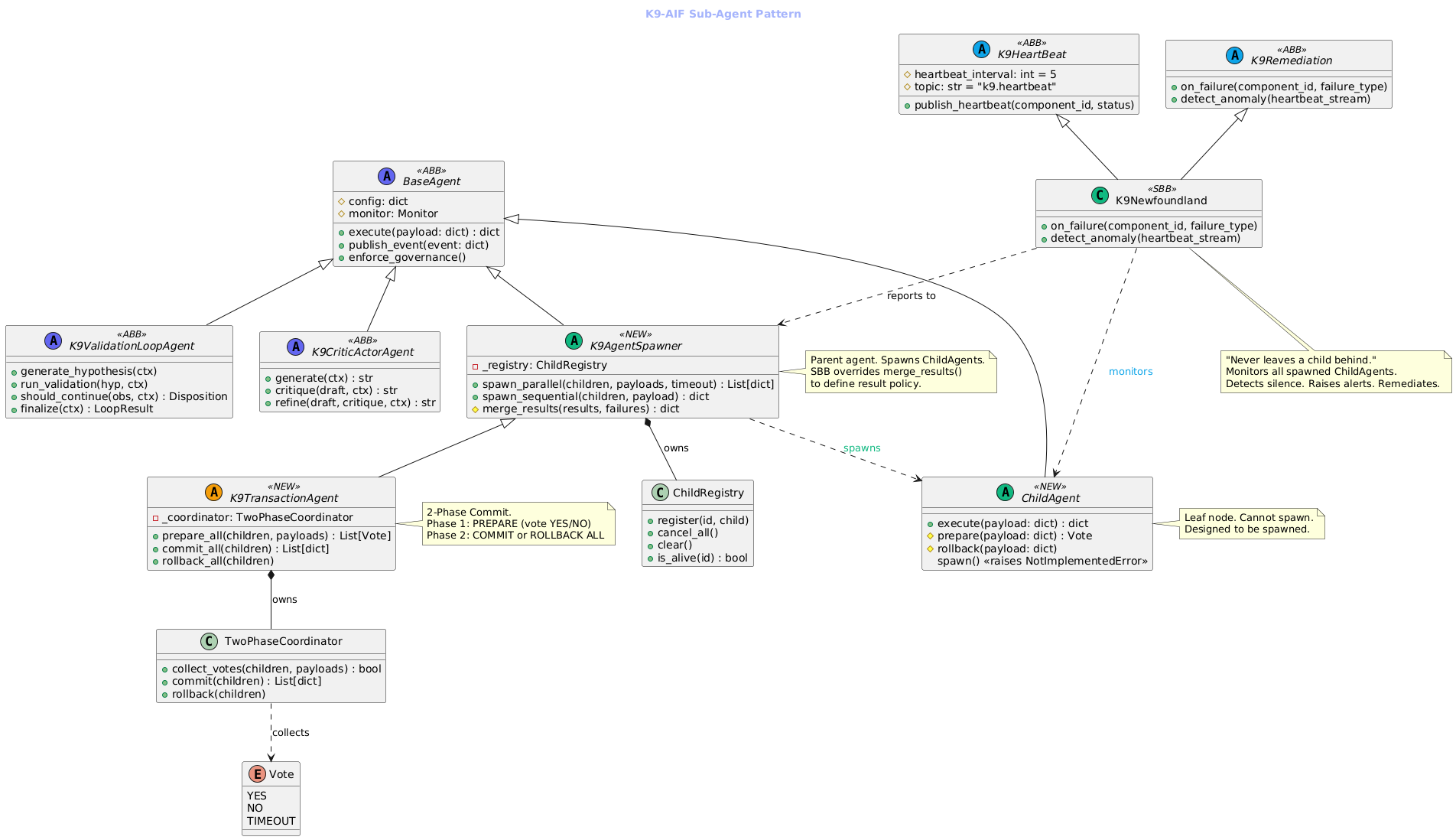
BaseAgent
├── K9ValidationLoopAgent     ← iterative convergence
├── K9CriticActorAgent        ← generate-critique-refine
├── ChildAgent                ← leaf node, cannot spawn (NEW)
└── K9AgentSpawner            ← spawns ChildAgents (NEW)
      └── K9TransactionAgent  ← 2-Phase Commit variant (NEW)
K9TransactionAgent: All-or-Nothing
For scenarios where partial results are unacceptable — payments, compliance filings, multi-system state changes — K9TransactionAgent extends K9AgentSpawner with 2-Phase Commit:
- Phase 1 — PREPARE: each child votes YES or NO
- Phase 2 — COMMIT if all YES, ROLLBACK if any NO
K9Newfoundland: The Watchdog That Never Leaves a Child Behind
Named after the loyal, protective Newfoundland breed — K9Newfoundland monitors every spawned ChildAgent, detects silence, raises alerts, and remediates failures. It never abandons its charges.
class K9Newfoundland(K9HeartBeat, K9Remediation):
    """
    Monitors spawned ChildAgents.
    Detects silence. Raises alerts. Remediates failures.
    Never leaves a child behind.
    """
    def on_failure(self, component_id, failure_type):
        if failure_type == "timeout":
            self.restart_agent(component_id)
        elif failure_type == "unresponsive":
            self.alert_human_operator(component_id)
K9HeartBeat (ABB) — each agent publishes liveness to k9.heartbeat. SBB defines what healthy means for that specific agent.
K9Remediation (ABB) — watchdog acts on silence or failure. SBB implements the strategy: restart, fallback, scale, or escalate to human.
The Pattern Is Not New. The Discipline Is.
Parallel agent execution exists in LangGraph, AutoGen, CrewAI, AWS Strands, and others. What K9-AIF adds is the enterprise discipline around it — formal ABB contracts, structural deadlock prevention, no-orphan guarantee, governance inheritance, and a result policy that the solution architect controls.
The sub-agent pattern applied. Within a governed enterprise architecture. That is the contribution.
References
- Butenhof, D.R. — Programming with POSIX Threads (Addison-Wesley, 1997, ISBN: 0201633922)
- Dijkstra, E.W. — Cooperating Sequential Processes (1965)
- Gray, J. — Notes on Database Operating Systems (1979)
- Gamma et al. — Design Patterns (Addison-Wesley, 1994)
- Hewitt, C. — A Universal Modular ACTOR Formalism for Artificial Intelligence (1973)
K9-AIF — Architecture-First Framework for Agentic AI · k9x.ai