One of the most interesting parts of the K9-AIF journey was not just building the framework itself — but visualizing it.
The result eventually became:
Live Graph: https://graph.k9x.ai
A live graph visualization of the K9-AIF framework structure, relationships, runtime components, orchestration layers, and example applications.
But the graph was never the starting point.
The architecture was.
Architecture First
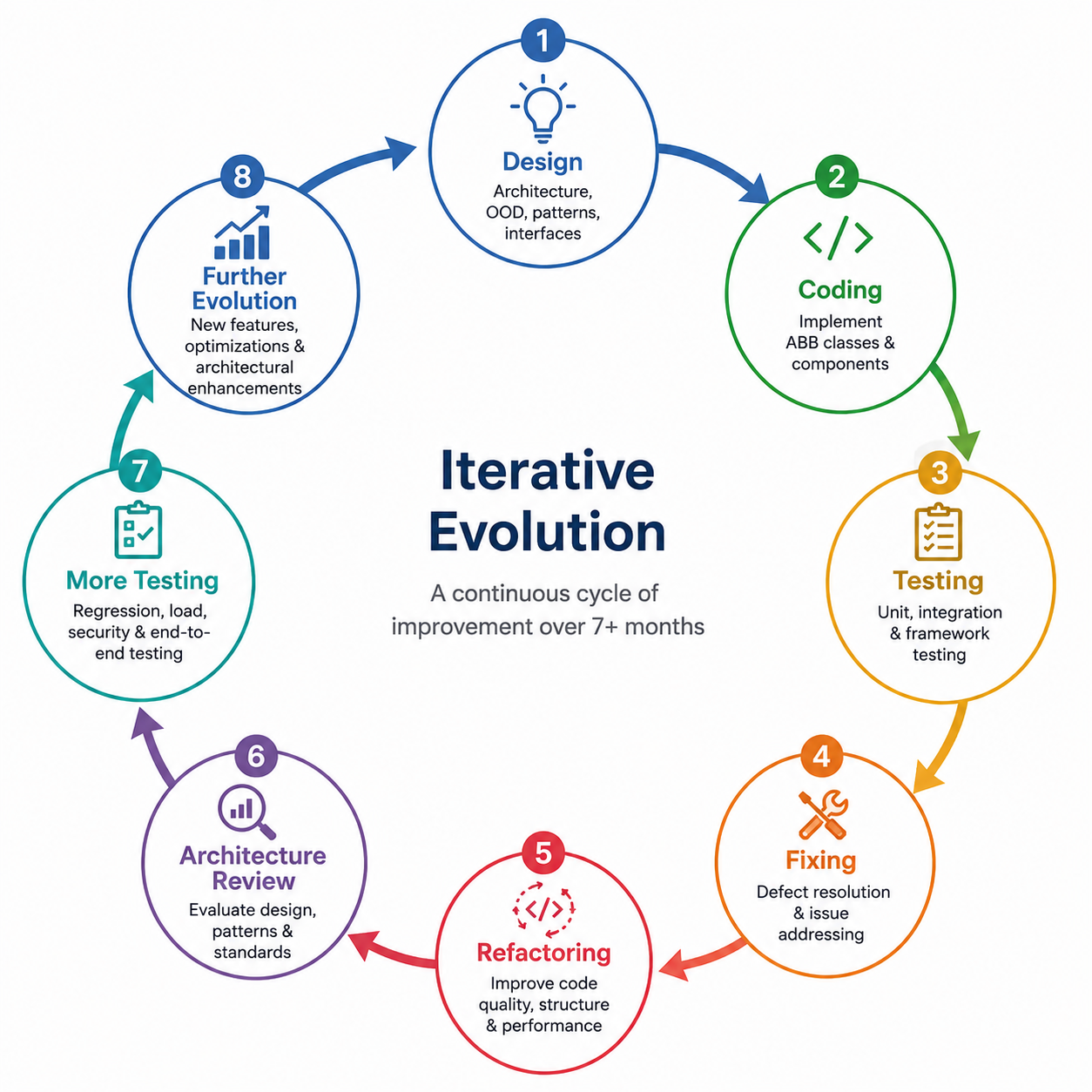
The K9-AIF framework ABB classes evolved over roughly seven months.
The graph was therefore not simply a visualization layer.
It became a living architectural representation of the framework itself.
From Framework Artifacts to Graph Generation
The graph generation process itself evolved iteratively alongside the framework.
The K9-AIF ABB classes, PlantUML diagrams, architectural relationships, and framework structures were used as structured input into an LLM-assisted process for generating Neo4j Cypher statements representing framework nodes and edges.
The overall flow evolved roughly like this:
Framework Artifacts
        ↓
ABB Classes + PlantUML + Relationships
        ↓
LLM Semantic Analysis
        ↓
Neo4j Cypher Generation
        ↓
Node + Edge Creation
        ↓
Manual Review and Relationship Tuning
        ↓
Testing and Visualization Refinement
        ↓
Continuous Graph Evolution
The Hard Part Was Not Neo4j
Neo4j itself was not the hardest part.
The harder challenge was deciding:
- What should be visualized?
- Which relationships matter?
- What views are useful?
- How should runtime flow appear?
- How should inheritance appear?
- What should architects see?
- What should developers see?
- What should orchestration views show?
- How should examples be isolated?
- Which relationships create clutter?
Several visualization layers eventually emerged:
- Framework Views
- Core ABB Views
- Runtime Views
- Example Application Views
- Inheritance Views
- Orchestration Flow Views
- Factory Relationship Views
The design of the graph navigation itself became an architectural exercise.
The Bigger Lesson
One major takeaway from the process was this:
Architecture-first systems naturally produce richer semantic graphs.
When architecture is intentional:
- AI reasoning improves
- Relationship inference improves
- Visualization quality improves
- Extensibility improves
- Governance improves
- Runtime traceability improves
The graph emerged as a natural byproduct of intentional architecture.
Closing Thoughts
graph.k9x.ai was never intended to be “just another graph visualization.”
It became an experiment in how architecture discipline, structured engineering, iterative framework evolution, and AI-assisted reasoning can work together.
And as the framework continues evolving, the graph evolves with it.
That may ultimately be the most important insight from the entire process.
K9-AIF
Architecture First.