Reading this piece on Building Deep Agents is what got this thought process going: agents that plan, remember, delegate, and grind through long tasks on their own — how does that line up against K9-AIF? Does the framework already support this, or is there a real gap?
Short answer: mostly yes. Walking through it pillar by pillar, K9-AIF’s ABB/SBB architecture already covers most of what “Deep Agent” describes. One piece was genuinely missing — dynamic, self-revising planning — so I added a new class to close it: K9PlanningLoopAgent, shipped today.
Here’s the walkthrough: what a Deep Agent is, a quick refresher on K9-AIF’s ABB/SBB model, and then how the two map onto each other.
What Is a “Deep Agent”?
LangChain’s deepagents package names a pattern for keeping a single agent productive over long, open-ended tasks — the kind of work that would otherwise blow out the context window or wander off-task. It rests on four pillars:
| # | Pillar | What it does |
|---|---|---|
| 1 | Detailed system prompt | A long, carefully structured prompt establishes role, constraints, and operating procedure up front |
| 2 | Planning tool | The LLM maintains an explicit todo list — writes it, checks items off, revises it as it learns more |
| 3 | Sub-agent spawning with context isolation | Work gets delegated to sub-agents that run in a clean context and report back only a summary — keeps the parent’s context from filling with sub-agent noise |
| 4 | Virtual filesystem | The agent reads/writes scratch files — working memory that persists across steps without living in the prompt |
Useful less as “code to adopt,” more as a checklist: does an agent already have an equivalent for each pillar, or is there a real gap?
K9-AIF, Briefly: ABB and SBB
K9-AIF’s architecture is built around two layers:
- Architecture Building Blocks (ABB) — abstract classes that define a contract: the interface, the lifecycle, the loop skeleton. No domain logic lives here.
BaseAgent,BaseValidationLoopAgent. - Solution Building Blocks (SBB) — concrete implementations. For specific ABBs, K9-AIF ships ready-to-run, out-of-the-box (OOB) defaults (
K9ValidationLoopAgent,K9ModelRouter, …) — extend and override only what your domain needs. Domain-specific agents (FraudDetectionAgent,DocumentExtractorAgent) are SBBs too, usually built on the OOB rather than the raw ABB.
BaseAgent (ABB)
  └── BaseValidationLoopAgent (ABB — loop skeleton)
        └── K9ValidationLoopAgent (OOB — ready-to-run default)
              └── FraudDetectionAgent (SBB — domain-specific)
Having said this, let’s see how the four Deep Agent pillars map onto this model.
Mapping the Four Pillars to K9-AIF
| # | Pillar | K9-AIF equivalent | Verdict |
|---|---|---|---|
| 1 | Detailed system prompt | role / goal fields in agent YAML (Skill 1, every BaseAgent) — declarative, not hand-rolled per agent |
Already covered |
| 2 | Planning tool (todo list) | (nothing — until today) | Real gap → closed by K9PlanningLoopAgent |
| 3 | Sub-agent context isolation | K9AgentSpawner / ChildAgent exists for parallel decomposition — but does not isolate context from the parent’s reasoning chain |
Deliberately different (see below) |
| 4 | Virtual filesystem / memory | notes: dict scratchpad in ValidationLoopContext, persisted via models/ to the routing state store / Neo4j |
Adopted, in lightweight form |
Three of four were either already covered or a conscious “different by design.” Planning was the one real gap.
Closing the Planning Gap: K9PlanningLoopAgent
K9-AIF already had an iterative-reasoning ABB: BaseValidationLoopAgent, with K9ValidationLoopAgent as its OOB implementation. So why a new class instead of extending that one?
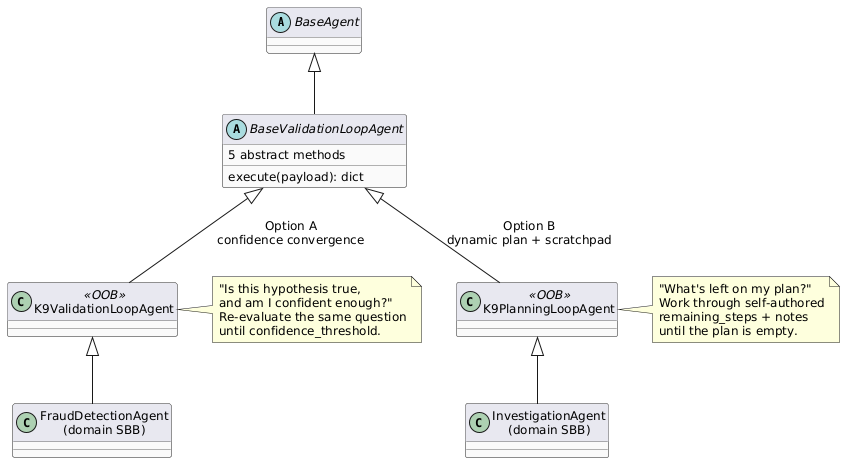
K9ValidationLoopAgent answers one question repeatedly: “Is this hypothesis true, and am I confident enough?” Each iteration re-evaluates the same assessment with the growing history of prior attempts as context. It converges on a single confidence score.
K9PlanningLoopAgent (new) works through a self-authored, revisable plan — the planning-tool pillar. Each iteration may tackle a different sub-task, drawn from a remaining_steps list the LLM maintains and updates every round, plus a notes scratchpad carried forward. The loop finalizes when the plan is empty (plan_complete) — confidence is a secondary/fallback signal, not the primary one.
Same loop skeleton (execute(), the five abstract methods, ValidationDisposition), different “brain”:
| Method | K9ValidationLoopAgent |
K9PlanningLoopAgent |
|---|---|---|
generate_hypothesis |
Prompt = role + goal + payload + prior iterations | Same, plus current plan + scratchpad |
evaluate_observation |
Parse {conclusion, confidence, reasoning, needs_more} |
Parse {..., remaining_steps, notes}; writes them back onto the loop context |
should_continue |
FINALIZE when confidence ≥ threshold |
FINALIZE when plan is empty or confidence ≥ threshold |
Both extend BaseValidationLoopAgent directly as siblings — additive, nothing existing changed.
Why K9-AIF Doesn’t Isolate Sub-Agent Context
The Deep Agent pattern isolates sub-agents on purpose: clean context in, summary out. That keeps the parent’s context window from filling with a sub-agent’s exploratory noise.
K9-AIF’s BaseSquad does close to the opposite, on purpose: each agent in a flow enriches the same shared context. By the time AuditAgent runs, it can see the triage agent’s reasoning, the fraud agent’s findings, and the adjudication agent’s conclusion — not a one-line summary of each.
That full trail is the point. “We approved this claim because Triage flagged X, FraudDetection found Y, Adjudication weighed Z — and here’s the reasoning behind each” is the answer an audit needs verbatim. A summarized sub-agent report can’t reconstruct that; full shared context can.
K9AgentSpawner / ChildAgent is isolated — for parallel work, no shared mutable state, no race conditions — but that’s solving concurrency safety, not “keep context off the audit trail.” Two different problems; K9-AIF already has an ABB for each, and isolating one didn’t require isolating the other.
Class Diagram — Two Ways an SBB Can Extend
The high-level shape: one ABB skeleton, two OOB “brains,” and the SA picks per-agent which one a Solution Building Block extends.
Solutions Architect Decision Table
The “which ABB does this agent extend” decision now has three rows:
| Question | Extend |
|---|---|
| Produces its answer in one pass | BaseAgent |
| Tests a hypothesis, re-evaluates until confident | K9ValidationLoopAgent |
| Works through an open-ended, multi-step task | K9PlanningLoopAgent |
| One-pass | Iterative confidence convergence | Open-ended dynamic planning |
|---|---|---|
| Triage, routing, audit, guard, graph sync | Fraud signal correlation, claims evidence, compliance gap, document confidence | Investigation, multi-step research, open-ended remediation |
Same rule as always: this is an explicit SA design-time decision per agent, not an automatic upgrade. Most agents in most squads should still be plain BaseAgent.
Status
K9PlanningLoopAgent is implemented and tested:
k9_aif_abb/k9_agents/planning/k9_planning_loop_agent.py— new OOB, ~230 linesk9_aif_abb/k9_agents/validation/models/validation_loop.py— additiveremaining_steps/notesfields onValidationLoopContextandValidationLoopResultk9_aif_abb/tests/test_k9_planning_loop_agent.py— 10 new tests, fully offline (LLM mocked)- Full suite: 219/220 pass (the 1 failure is a pre-existing live-Ollama smoke test, unrelated)
SKILLS.mdSkill 10 — updated hierarchy and the three-way SA decision table above
While I Was At It — AGENT.md
A related question came up around the same time: do we need an AGENT.md?
AGENT.md (and its sibling AGENTS.md) is a convention some tools use for “how should an AI coding assistant behave in this repo” — build commands, conventions, do’s and don’ts. K9-AIF already has this, split across CLAUDE.md (root-level guidance: pre-push checklist, hooks, commands, architecture map) and SKILLS.md (the pattern catalog: every ABB, the Skill recipes, decision tables for SAs).
Both were deliberately written as LLM-agnostic context files — no Claude-specific assumptions. Any coding assistant looking for a generic instructions file is reading the same content CLAUDE.md already provides. Adding AGENT.md would mean either duplicating the content (and the two drift apart over time) or making it a one-line pointer (a hop, no new information). Single source of truth wins. If a specific tool hard-requires the exact filename, a one-line redirect is cheap — but that’s a tooling accommodation, not an architecture decision.
Takeaway
Most of “Deep Agent” was already in K9-AIF, under different names — role/goal is the system prompt, the squad’s shared context is the working memory, K9AgentSpawner is the sub-agent mechanism. One piece was a genuine gap, and it’s closed now: K9PlanningLoopAgent gives agents a self-revising plan and scratchpad, the same way K9ValidationLoopAgent gives them confidence-driven convergence. Two OOB “brains,” one ABB skeleton, and the SA picks per agent — that’s the architecture, and it’s additive all the way down.
K9PlanningLoopAgent and K9ValidationLoopAgent are available in k9_aif_abb/k9_agents/. The full usage guide is in SKILLS.md. The framework is open source at github.com/k9aif/k9-aif-framework.