Date: 2026-05-23
Author: Ravi Natarajan
I actually built the EOC example using Claude Code. The result is the K9X Enterprise Insurance Operations Center — a production-grade, runnable multi-agent application covering claims processing, fraud detection, document intelligence, HITL escalation, and governed audit trails. Here’s exactly how I built it — and you can do the same for your own domain.
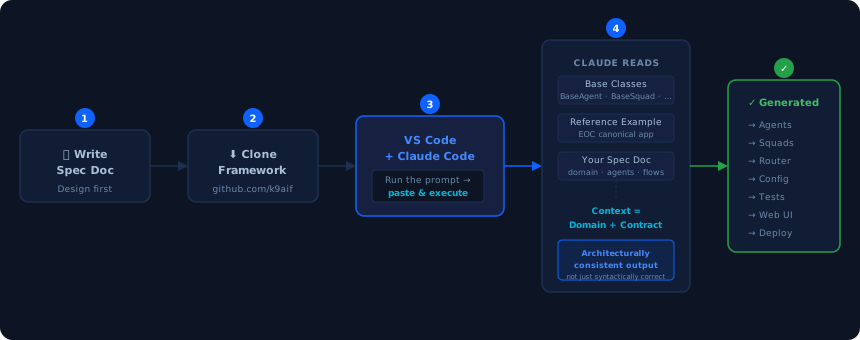
Prerequisite: Write your spec doc first
This is the real work. Think through your domain: what agents, what events, what flows. Document it — same format as the K9-AIF EOC Project Spec reference.
Architecture-first means you design before you code. Claude Code enforces that discipline.
Steps
1. Install the framework
pip install k9-aif
2. Create your project folder and drop in your spec doc
examples/[YourProjectName]/docs/your-spec.docx
3. Open in VS Code with Claude Code integrated
4. Run this prompt:
You are building a new application example on top of the K9-AIF framework located at
k9_aif_abb/.Project details:
- Application name: [e.g., K9X_Healthcare_ClaimsProcessor]
- Create all files under:
examples/K9X_Healthcare_ClaimsProcessor/- Spec doc location:
examples/K9X_Healthcare_ClaimsProcessor/docs/your-spec.docxBefore writing any code, read:
CLAUDE.md— framework architecture, execution hierarchy, and contractsSKILLS.md— development recipes for agents, squads, LLM invocation, and governance- The canonical reference example:
examples/K9X_Enterprise_Insurance_OperationsCenter/- The project specification document above.
Then implement the new example following the same structure and conventions as the reference. Rules:
- Every agent must extend
BaseAgentand implementexecute()- Every squad must be defined in a squad YAML with a
flow- The router must route by
event_type- Governance must be explicit — do not use
NoopGovernancein production code- Folder structure, naming, and config patterns must match the reference example
Why this works
The spec doc defines the business domain.
The reference example defines the framework contract.
CLAUDE.md and SKILLS.md give Claude Code the architecture and the recipes — so it knows not just what the framework is, but exactly how to build in it.
Together, they give Claude Code enough context to generate code that is architecturally consistent — not just syntactically correct.
That’s the difference between a scaffold and a solution.
Try it and let me know what you build.
Want to see the full output? Browse the K9X Enterprise Insurance Operations Center on GitHub — the example application generated using exactly this approach.