The Problem
Agent frameworks like CrewAI make it incredibly easy to build intelligent workflows.
You can define agents, assign tasks, connect tools — and within minutes, you have a working system.
But as systems grow, a question emerges:
Who owns the architecture?
- Where does orchestration live?
- How do we enforce governance?
- How do we integrate multiple agent systems?
- How do we evolve without rewriting everything?
This is where most solutions stop.
The Idea
Instead of replacing agent frameworks, what if we wrapped them with an architecture layer?
That’s the approach behind K9-AIF.
CrewAI executes.
K9-AIF governs.
The Approach
We built a simple Weather Assist application in two ways:
1. Pure CrewAI (Standalone)
User-> CrewAI -> Agents -> Output
- Fast to build
- Direct execution
- No architectural boundary
2. K9-AIF Integrated
Same application. Different architecture.
Integration Class Diagram
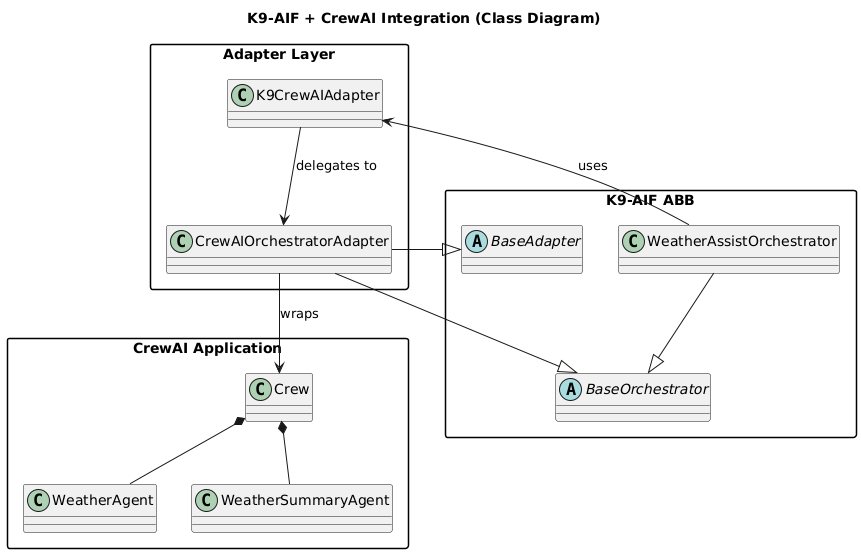
This diagram illustrates how a standalone CrewAI application is integrated into K9-AIF using an adapter-based architecture, with clear separation between orchestration, integration, and execution layers.
Key Components
K9-AIF (Architecture Layer)
BaseOrchestratorWeatherAssistOrchestrator
This becomes the entry point of the system.
Adapter Layer
K9CrewAIAdapterCrewAIOrchestratorAdapter
This is the bridge.
It allows CrewAI to plug into K9-AIF without modifying CrewAI itself.
CrewAI (Execution Layer)
CrewWeather AgentWeather Summary Agent
This remains unchanged.
The Flow
Here’s what happens at runtime:
K9 Orchestrator → Adapter → CrewAI → Agents ← Result ← Normalized Output
And importantly:
- K9 controls input
- K9 controls output
- CrewAI focuses only on execution
Class-Level Architecture
The integration is not just runtime — it is structural.
WeatherAssistOrchestratorextendsBaseOrchestratorCrewAIOrchestratorAdapterextends:BaseOrchestratorBaseAdapter
This means:
CrewAI is now constrained by architectural contracts
What This Enables
Right now, this demo shows clean integration.
But the real value comes next.
Because now you can add:
Governance
- Validate payloads
- Enforce policies
- Control execution boundaries
Routing
- Route to multiple orchestrators
- Support multiple domains (weather, claims, support)
Model Routing
- Centralized LLM selection
- Session-aware execution
- Cost / latency optimization
Observability
- Execution tracing
- Graph-based visualization (Neo4j)
- Architecture you can navigate
Why This Matters
Without an architecture layer:
Every agent framework becomes its own system.
With K9-AIF:
Agent frameworks become pluggable execution components
⚡ Key Insight
This is not about replacing CrewAI.
It’s about elevating it into a governed, extensible system architecture.
Final Thought
We often focus on making agents smarter.
But in real systems, the challenge is not intelligence — it’s structure.
The future of agent systems is not just agents.
It is architecture-first agent orchestration.
Explore
- Code: https://github.com/k9aif/k9-aif-framework
- Graph Explorer: https://graph2.k9aif.com
- Framework: https://k9aif.com