Date: 2026-03-14
Author: Ravi Natarajan
Motivation
As multi-agent AI systems grow, having an orchestrator manage every individual agent directly can become harder to scale, test, and govern.
K9-AIF introduces Agent Squads as a higher-level architectural abstraction for organizing agents into reusable execution groups.
Instead of treating every agent as an isolated runtime unit, K9-AIF allows related agents to be grouped into a squad that can execute within a shared context and under a defined orchestration model.
Architecture
K9-AIF follows a layered runtime structure:
Router → Orchestrator → Squads → Agents
In this model:
- the Router determines where work should go
- the Orchestrator coordinates the execution flow
- a Squad represents a bounded group of cooperating agents
- individual Agents perform specialized tasks inside the squad
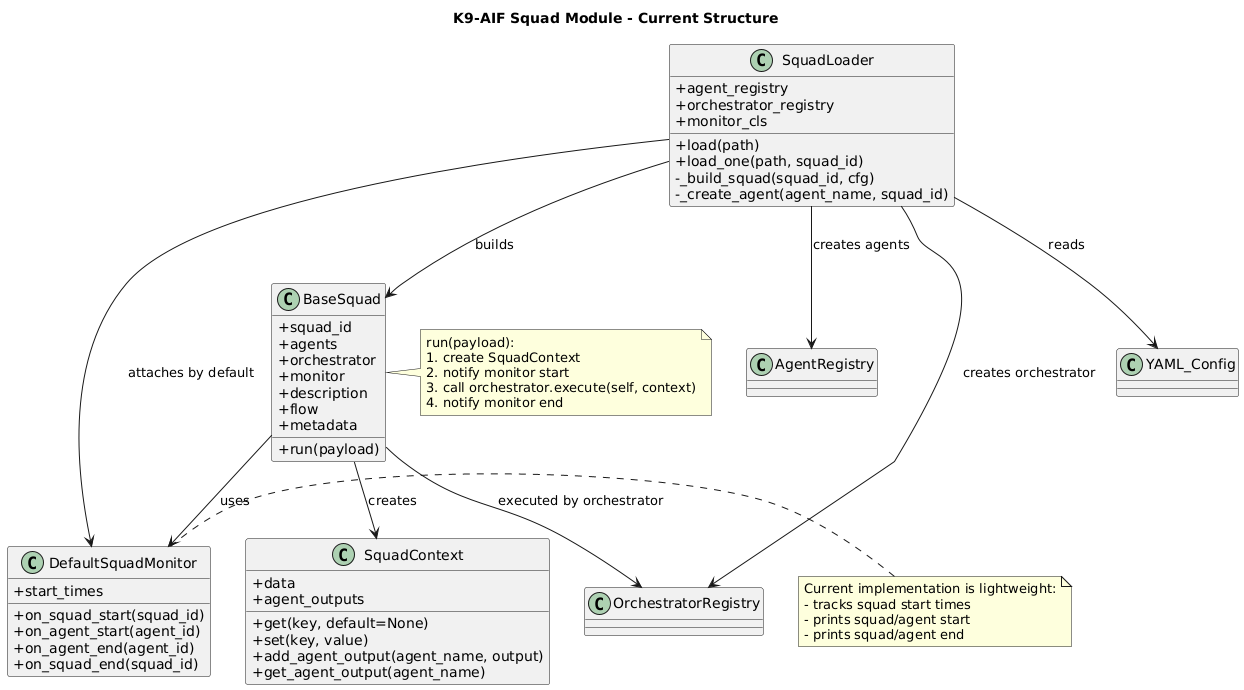
Squads provide a cleaner boundary between orchestration and execution. They make it easier to define, reuse, and evolve business-aligned agent groups without forcing the orchestrator to manage every agent relationship directly.
Why Squads Matter
As systems grow, flat agent-to-agent designs can become difficult to reason about. Squads help introduce structure.
With squads, K9-AIF can support:
- clearer execution boundaries
- better modularity and reuse
- configuration-driven assembly
- shared execution context across related agents
- cleaner separation between orchestration and agent behavior
This makes the architecture easier to extend as the number of agents, flows, and business use cases grows.
Core Squad Components
K9-AIF introduces the following squad-related components:
BaseSquad
BaseSquad defines the runtime execution unit for a squad.
It acts as the container for grouped agents and their orchestration flow.
SquadLoader
SquadLoader supports configuration-driven loading of squads,
making it easier to declare squad structures without hardcoding them
directly in application logic.
SquadContext
SquadContext provides shared state for the squad during execution,
allowing agents in the same squad to work with common contextual data.
DefaultSquadMonitor
DefaultSquadMonitor provides basic observability into squad execution.
Its role is to support visibility into squad activity rather than
to perform business work itself.
What Squad Monitoring Means
A squad monitor is not another business agent.
Its purpose is to provide runtime visibility into how a squad is executing. This can include events such as squad start, squad end, agent activity, and other operational signals that help make the system easier to observe and evolve.
Over time, this monitoring model can grow to support richer telemetry, governance hooks, and operational insight.
Benefits
Agent Squads bring several advantages to K9-AIF:
- cleaner orchestration boundaries
- modular multi-agent composition
- shared context for related agents
- configuration-driven squad definitions
- a better foundation for future monitoring and governance
Why This Fits K9-AIF
K9-AIF is designed as an architecture-first framework. That means runtime structures should reflect deliberate architectural boundaries, not just ad hoc collections of agents.
Squads help achieve that by introducing an intermediate execution layer between orchestrators and individual agents.
This makes K9-AIF better suited for enterprise-scale systems where maintainability, reuse, visibility, and governance matter.
Next Steps
Future releases can extend squad capabilities further in areas such as:
- richer monitoring and telemetry
- parallel squad execution patterns
- cross-squad coordination
- stronger governance and policy hooks
- more advanced loader and configuration models
Agent Squads are an important step toward making K9-AIF more structured, more extensible, and more operationally clear as agentic systems grow.
Learn More
K9-AIF is an architecture-first framework for modular and governed agentic AI systems.
More at: